

Now that previews of WHFRP 4th edition have actually been released, I thought it might be an appropriate time to do a post about the game's first two editions: what they achieved, why they mattered, how they differed from one another and from the wargame they branched off from, and so on. But once I got going I discovered I actually had quite a lot to say. So this is going to be a series of posts rather than just one.

Like many British gamers, Warhammer was a big part of my childhood. My older half-brother, Rob, had been a Warhammer fan back in the mid-1980s, when the wargame had just been getting started; but in his late teens he moved onto other, cooler things, like meeting girls and playing the guitar, and when I was about 12 he gave me his collection of old White Dwarf magazines and a couple of beautifully-painted chaos warriors. (He was an artist for a while. I've always envied his skill with a brush.) At the time I was still reeling from my discovery of Dragon Warriors, so giving someone with my recently-acquired love of dark historical horror-fantasy a pile of early White Dwarf magazines, Ian Miller art and all, was like pouring oil on a bonfire. For more years than I like to think about, every penny of hoarded pocket money was spent on buying skaven warriors for Warhammer and tiny plastic orcs for Space Marine. (Remember Space Marine?) I even tried my hand at painting some of them, although I was never very good at it.
So I was playing Warhammer in the 1990s, which I gather counts as 'Oldhammer' by modern standards; but because the gift of Warhammer had come to me by inheritance, I always felt that my Warhammer, the real Warhammer, wasn't the Warhammer in the Games Workshop shops I visited, but the early 1980s version I'd read about in the magazines which had been bequeathed to me. Even then, it was obvious to me that a huge amount had changed between the first edition published in 1983 and the fourth edition version that I was playing in 1993-6: it had been made shinier, more heroic, more kid-friendly, more marketable. There was less historical grounding, less black humour, less sex and violence, less satirical Blackadder-esque grimness and grime. (Warhammer 5th edition, which came out in 1996, took these changes even further, and marked the point at which I started sliding away from the wargame entirely.) With the knowledge I have now, I can retrospectively diagnose it as an example of 1980s British counter-culture being absorbed by 1990s consumerism, and ideologically neutralised in the process. At the time, though, I just knew that something had changed, and that while I liked the version of Warhammer I was playing, on some important level it was not the same.

As a result of all this, when I finally obtained a copy of the first edition of Warhammer Fantasy Roleplay, it came as a bit of a revelation. My copy was from the 1995 Hogshead reprint edition, but the text was identical to that of the original 1986 version, and thus served to connect me to that almost-vanished world of very early Warhammer which Games Workshop was then trying to expunge entirely. The version of the Warhammer World I encountered in WFRP, and later in the first three parts of The Enemy Within (1987-8, reprinted 1995-7), was so much more vivid than the one that was then being marketed by GW that it won me over almost immediately. I promptly gave up on the Warhammer wargame and turned, instead, to running a multi-year WFRP campaign that remains one of the best and most successful RPG campaigns I've ever had the pleasure of participating in.
The original, 1983-vintage Warhammer World is an extraordinary creation, and I don't think it gets nearly enough credit. Very little in it was genuinely original, in that it just gleefully mashed together early modern history with Tolkien, Moorcock, Hammer Horror, and 2000AD: the skaven and the chaos dwarves are just about the only significant parts of the setting that weren't ripped off from somewhere else. But the resulting mixture was so compelling that it basically invented a new subgenre on the spot, or at any rate reinvented a subgenre that had previously consisted only of a handful of Solomon Kane stories from the 1930s. It provided an enormously influential model of how to combine fantasy with horror: so much so that even today, twenty-five years later, virtually every work of 'dark fantasy' is full of Warhammer pastiches. In particular, the drawings that John Blanche and Ian Miller did for Games Workshop in the early 1980s created an aesthetic that has endured largely unmodified down to the present day.
(Well, apart from the infusion of assorted anime-isms. You can blame Castlevania for those.)

It helped, of course, that Games Workshop in its early days was lucky enough to include some of the most talented artists and designers who have ever worked in the hobby. Space marines were an instant design classic. So were chaos warriors. So were the Sisters of Battle, who seem to have been based on a random painting by John Blanche. (If you want proof of how good these designs were, take a look at how many other companies went on to produce their own imitation versions.) Orcs as hulking greenskins with tusks have now become so ubiquitous in fantasy that it takes a moment to remember that, before Warhammer, they were usually ugly, scrawny pig-men instead. And so on.
Warhammer Fantasy Roleplay was just as much of a mash-up as its parent game, although in its case the key ingredients were Dungeons and Dragons and Call of Cthulhu. Its biggest innovation was its famous careers system, which meant that instead of the PCs being fighters and clerics and wizards they were usually agitators and rat-catchers and printer's apprentices and whatnot. Again, in retrospect I can see the influence of the British Marxist historiography of the 1970s, here, with its emphasis on 'history from below': but at the time I just knew that its focus on the frantic struggles of the urban poor made the game feel vastly more grounded than Dragonlance or the Forgotten Realms. It was the increasing disconnect between the wargame, which by 5th edition was all about magical superheroes riding dragons, and the RPG, which was more about alcoholic gamblers knifing cultists in slums, which led me to abandon the former for the latter.

Just as Warhammer 1st edition had great good fortune in its artists and designers, so WHFRP 1st edition benefited from the work of three of the best RPG adventure writers of all time. Jim Bambra, Graeme Morris, and Phil Gallager, whom old-school D&D fans will know as the authors of the superb B10 Night's Dark Terror, all helped to write the first edition of WHFRP. [Edit: Graeme DAVIS wrote WHFRP. He's not the same guy as Graeme MORRIS, who wrote Night's Dark Terror. Thanks to Gideon for pointing this out!] They then went on to write the adventures Shadows Over Bögenhafen, Death on the Reik, and 'Rough Night at the Three Feathers'. Brilliant and justly famous as adventures, these modules, along with Carl Sargent's Power Behind the Throne, cemented a model of 'real' WHFRP as being, essentially, Call of Cthulhu in seventeenth-century fantasy Germany. The WHFRP setting notionally contained elves and dwarves and orcs and dragons and all the rest of the trad fantasy paraphernalia that it had inherited from Tolkien and Gygax, but these adventures eschewed such material almost entirely in favour of investigating the dark doings of criminals, cultists, mutants, and demons in grimy early modern cityscapes. The result was a gap between the RPG and the wargame which must have seemed increasingly unbridgeable by the time Games Workshop handed the former over to Flame Publications in 1990.
When the second edition came out in 2005-7, its authors faced at least three problems. The first was the difficulty of reconciling the heritage of 1980s WHFRP with the then-canonical setting of 6th and 7th edition Warhammer, which had become a much more heroic, high-magic, high-fantasy affair. The second was a business model - common in the RPG industry at the time - which required them to churn out as much product as possible, leading them to print twenty-five books for the game in just three years, compared to twelve books in five years for the original Games Workshop edition. The third was the simple fact that they didn't have anyone on their staff capable of creating material on the same level as Bambra, Davis, Gallager, Blanche, Miller, and the rest of the original GW crew. The result is that book for book, adventure for adventure, and image for image, the 2005-7 edition is much weaker than the 1986-1990 original. Moving from the hallucinatory fever-dream of the first edition chaos sourcebook Slaves to Darkness (1988) to the generic 'dark fantasy' filler of its second edition counterpart, The Tome of Corruption (2006), is a pretty depressing experience, while a comparison between the old and new adventures in the 2005 WHFRP adventure anthology Plundered Vaults demonstrates just how many of the principles of RPG adventure design had been forgotten or misunderstood in the intervening years, even by people who clearly had the originals right in front of them.
Despite this, however, there were quite a lot of things in WHFRP 2nd edition that I actually rather liked. So over the next few posts I'm going to move briefly through the line, discussing what I felt did or didn't work, and why, and what this might tell us about the strengths and weaknesses of WHFRP as a whole.
I will also be writing quite a lot about skaven.
Once a skaven player, always a skaven player.
Just as Warhammer 1st edition had great good fortune in its artists and designers, so WHFRP 1st edition benefited from the work of three of the best RPG adventure writers of all time. Jim Bambra, Graeme Morris, and Phil Gallager, whom old-school D&D fans will know as the authors of the superb B10 Night's Dark Terror, all helped to write the first edition of WHFRP. [Edit: Graeme DAVIS wrote WHFRP. He's not the same guy as Graeme MORRIS, who wrote Night's Dark Terror. Thanks to Gideon for pointing this out!] They then went on to write the adventures Shadows Over Bögenhafen, Death on the Reik, and 'Rough Night at the Three Feathers'. Brilliant and justly famous as adventures, these modules, along with Carl Sargent's Power Behind the Throne, cemented a model of 'real' WHFRP as being, essentially, Call of Cthulhu in seventeenth-century fantasy Germany. The WHFRP setting notionally contained elves and dwarves and orcs and dragons and all the rest of the trad fantasy paraphernalia that it had inherited from Tolkien and Gygax, but these adventures eschewed such material almost entirely in favour of investigating the dark doings of criminals, cultists, mutants, and demons in grimy early modern cityscapes. The result was a gap between the RPG and the wargame which must have seemed increasingly unbridgeable by the time Games Workshop handed the former over to Flame Publications in 1990.
When the second edition came out in 2005-7, its authors faced at least three problems. The first was the difficulty of reconciling the heritage of 1980s WHFRP with the then-canonical setting of 6th and 7th edition Warhammer, which had become a much more heroic, high-magic, high-fantasy affair. The second was a business model - common in the RPG industry at the time - which required them to churn out as much product as possible, leading them to print twenty-five books for the game in just three years, compared to twelve books in five years for the original Games Workshop edition. The third was the simple fact that they didn't have anyone on their staff capable of creating material on the same level as Bambra, Davis, Gallager, Blanche, Miller, and the rest of the original GW crew. The result is that book for book, adventure for adventure, and image for image, the 2005-7 edition is much weaker than the 1986-1990 original. Moving from the hallucinatory fever-dream of the first edition chaos sourcebook Slaves to Darkness (1988) to the generic 'dark fantasy' filler of its second edition counterpart, The Tome of Corruption (2006), is a pretty depressing experience, while a comparison between the old and new adventures in the 2005 WHFRP adventure anthology Plundered Vaults demonstrates just how many of the principles of RPG adventure design had been forgotten or misunderstood in the intervening years, even by people who clearly had the originals right in front of them.
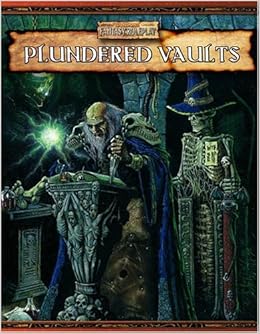 |
| Did you even read 'Rough Night at the Three Feathers' before reprinting it? |
Despite this, however, there were quite a lot of things in WHFRP 2nd edition that I actually rather liked. So over the next few posts I'm going to move briefly through the line, discussing what I felt did or didn't work, and why, and what this might tell us about the strengths and weaknesses of WHFRP as a whole.
I will also be writing quite a lot about skaven.
Once a skaven player, always a skaven player.






0 Yorumlar